The Early Days: Browser Games Before Flash
Browser games predate Flash by quite a bit. The earliest browser-based games were simple text adventures and turn-based games built in plain HTML, running in the earliest web browsers of the 1990s. These were primitive by any modern standard but represented something genuinely new — games that ran directly in the browser window rather than requiring software installation. As JavaScript matured in the mid-to-late 1990s, more interactive experiences became possible, including early versions of classics like Snake, which became famous as a Nokia phone game around this era. The web was slow, screens were small, and graphic capabilities were minimal, but the concept of instant, no-installation gaming was established.
The Flash Era: Browser Gaming's Golden Age
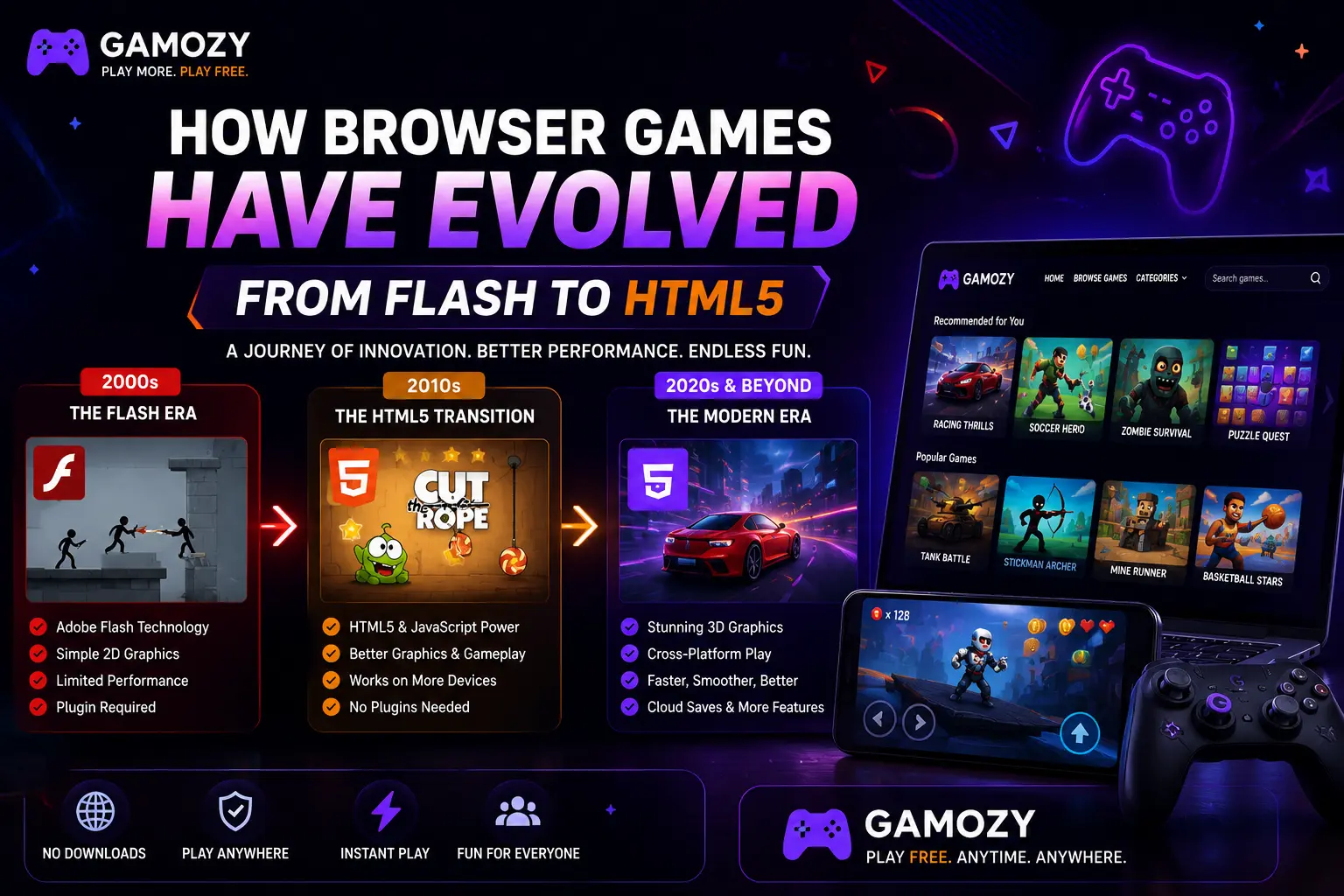
Adobe Flash defined browser gaming for roughly a decade, from the early 2000s to around 2015. Flash enabled rich 2D animation, sound, and interactivity that plain HTML and early JavaScript couldn't match, and the result was an explosion of creative browser game development. Platforms like Newgrounds, Miniclip, and Kongregate became home to vast libraries of Flash games covering every genre imaginable. For many people now in their 20s and 30s, Flash games are deeply nostalgic — a formative gaming experience that happened in a browser tab on a family computer during the dial-up and early broadband era. The creative energy of the Flash era produced genuinely memorable games despite technical constraints.
The End of Flash and the HTML5 Transition
Flash's decline began around 2010 when Apple famously refused to support it on the iPhone. Security vulnerabilities accumulated, Adobe's commitment to the technology waned, and HTML5 combined with modern JavaScript emerged as a superior alternative. The formal end came on December 31, 2020, when Adobe officially ended Flash support and modern browsers stopped running Flash content entirely. This could have been catastrophic for browser gaming, but the industry had already largely transitioned. HTML5 canvas, WebGL, and modern JavaScript APIs had matured to the point where the best HTML5 games matched and in many ways exceeded what Flash could produce, particularly for mobile compatibility.
HTML5 Today: The Mature Browser Gaming Era
The HTML5 era of browser gaming is in many ways its most capable and most accessible. Games run natively in any modern browser on any device — phone, tablet, laptop, Chromebook, smart TV — without any plugin, extension, or installation. Performance has improved dramatically as browsers have optimized their JavaScript engines and graphics APIs. The mobile compatibility that Flash always struggled with is now native and excellent for HTML5. Gamozy represents the HTML5 browser gaming model at its best — a curated library of high-quality games that load instantly and play smoothly across every platform, completely free and accessible to anyone with a browser and an internet connection.
What's Next: The Future of Browser Gaming
The trajectory of browser gaming points toward increasingly capable experiences. WebGPU, the next-generation graphics API for browsers, promises game performance approaching native applications. Progressive Web App technology allows browser games to be installed to home screens and run with more native-app-like experiences, including offline capability. Cloud gaming is bringing high-end game streaming to browsers, though this requires excellent internet connections. But the core appeal of browser gaming — instant access, no downloads, free-to-try, cross-device — isn't going anywhere. If anything, the convenience advantages of browser gaming become more valuable as gaming hardware becomes more fragmented and consumers grow warier of complex platform ecosystems.
Frequently Asked Questions
Recommended Gamozy Games
Try these related free browser games after reading the guide.